Tennis analysis

Tennis Analysis for Smarter Match Research

Good tennis analysis is not just checking scores, rankings or recent form. TennisJack turns player history, match context, set behavior, live situations and statistical signals into a clearer research framework.

Analytics can support better decisions, but they do not guarantee outcomes.

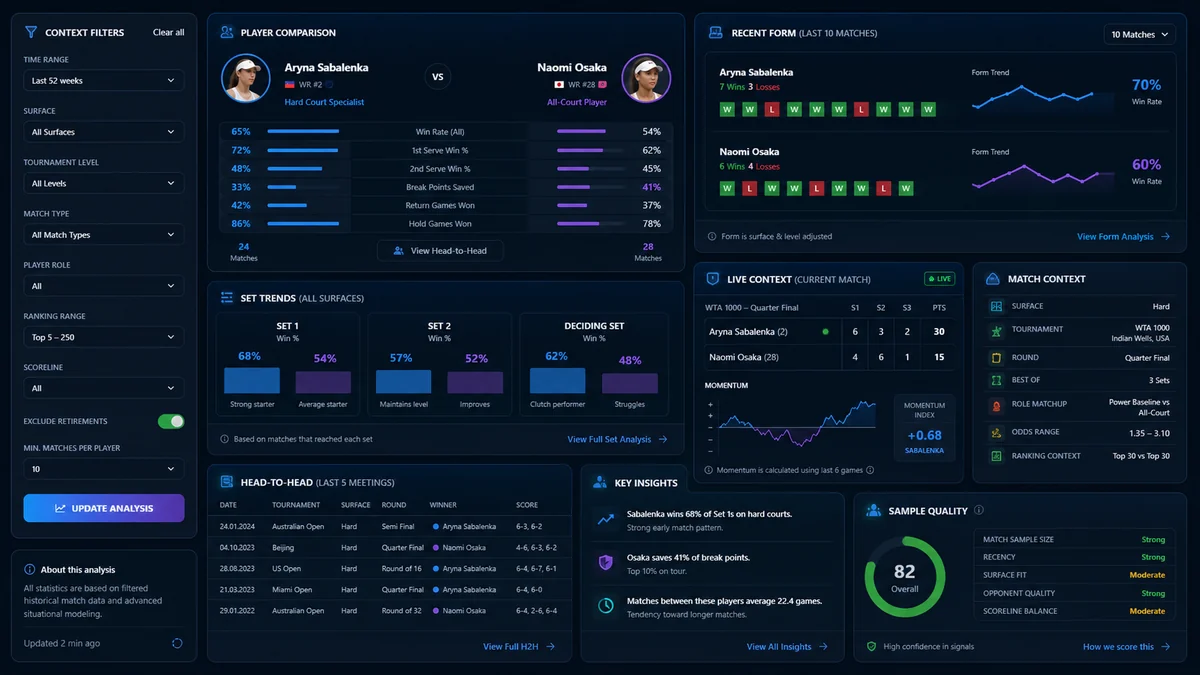
Professional tennis analysis dashboard with player history, match context and set trend data
Analysis command center Player history + match context + sample quality
01

What tennis analysis means

Tennis analysis transforms raw match data into useful context. Win rate, ranking and recent form become stronger when they are filtered by surface, opponent level, role, time period, set result, odds range and match situation.

02

From player history to match context

Every tennis match starts with two players, but strong analysis goes deeper than names and rankings. TennisJack helps users review recent form, surface performance, favorite and underdog roles, set behavior, pressure points and opponent quality.

03

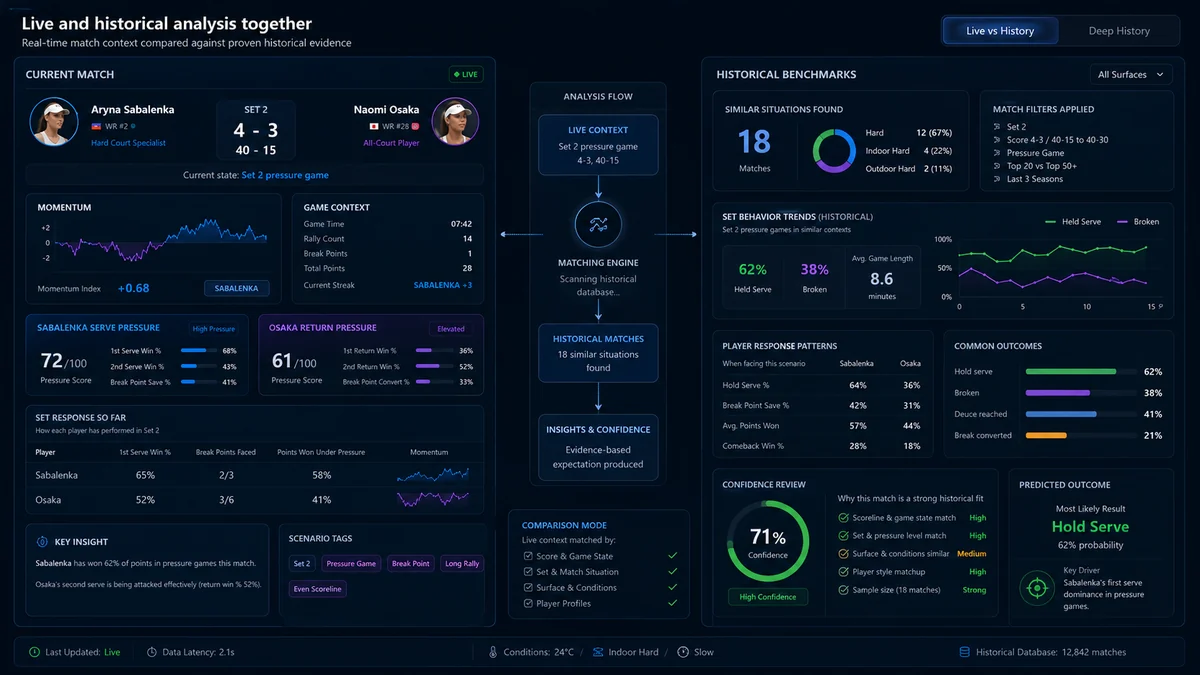
Live and historical analysis should work together

Live tennis analysis can become emotional because momentum changes quickly. TennisJack keeps live research connected to historical evidence, similar score states and relevant player behavior.

04

Set trends, streaks and repeated patterns

First set performance, deciding-set frequency, over 2.5 set trends, close sets and surface-specific sequences can reveal useful research angles when they are filtered and reviewed with sample quality.

Sample quality

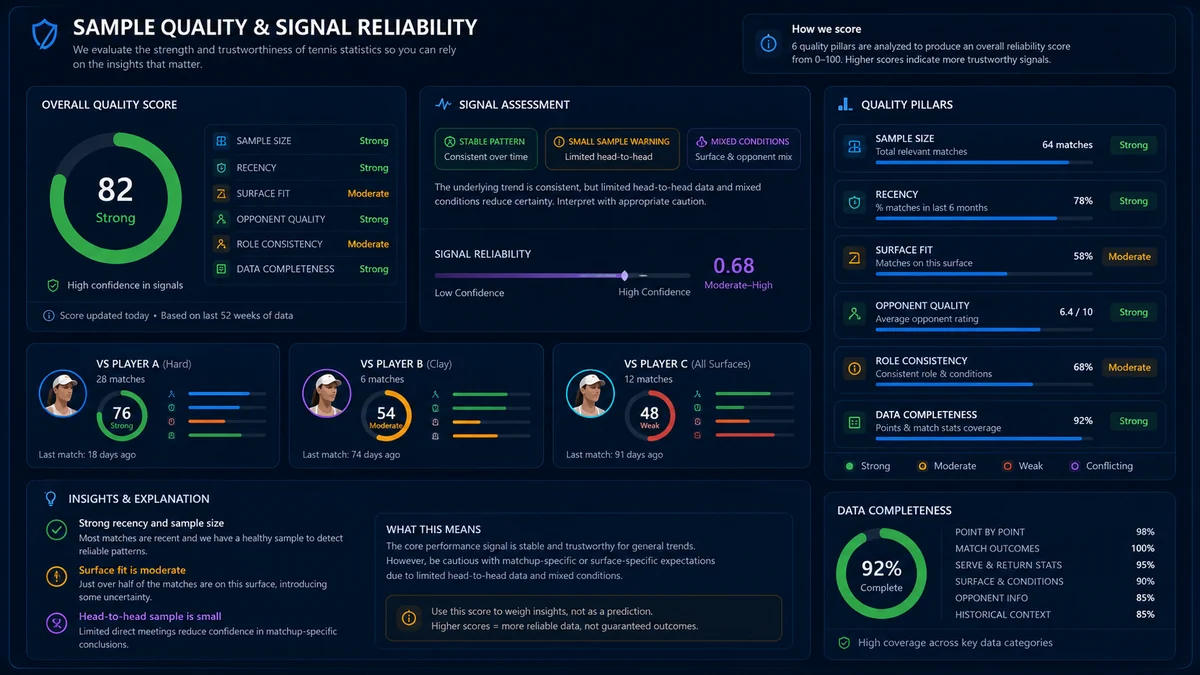
Sample quality matters before any tennis signal is trusted.

A strong-looking number from three matches is not the same as the same number from fifty matches. Tennis analysis should show where the data comes from and what may weaken it.

  • How many matches are included?
  • Which surface is being studied?
  • Was the player a favorite or an underdog?
  • What odds range is being analyzed?
  • Is the trend recent or long-term?
  • Does the pattern survive controlled filters?
  • Are there contradictory signals?
Tennis analysis sample quality interface showing strong signals, weak samples and conflicting data
Analysis framework

A repeatable workflow for tennis match research.

A single opinion is difficult to improve. A structured process can be reviewed, tested and refined.

01

Research the players

Start with form, surface, role, rankings and historical results.

02

Compare match context

Review opponent quality, market role, odds range and shared conditions.

03

Inspect set behavior

Look at first sets, deciding sets, pressure games and game-state patterns.

04

Review streaks

Study repeated sequences such as over 2.5 sets, favorite-role runs and close-set trends.

05

Judge reliability

Decide whether the signal is strong enough or still too weak to trust.

Live plus history

Live and historical analysis together

Current match state becomes more useful when it is compared with historical benchmarks. Live tennis analysis should be grounded in score context, pressure data, similar situations and confidence review.

Live context Similar situations Historical confidence
Live tennis analysis dashboard comparing current match context with historical benchmarks
Player comparison

Player comparison creates better matchup analysis.

A player's strengths only matter in relation to the opponent. TennisJack supports matchup research by helping users compare players across shared statistical dimensions.

  • Which player has stronger evidence under similar conditions?
  • Which player performs better in the current surface and role?
  • Which player has more stable set-level behavior?
  • Which recent form is supported by a larger sample?
  • Which data points contradict the first match view?
Analysis vs betting tools

Tennis analysis is broader than betting tools.

The Tennis Analysis page explains the full research process: players, matches, form, context, set behavior, live situations, streaks and data quality. Betting tools are one possible use case built on top of that foundation.

  • Tennis analysis explains the research workflow.
  • Betting tools focus on odds context and betting-intent questions.
  • Analysis is the foundation for player, match and market research.
Odds context

Odds context belongs inside serious tennis analysis.

Odds are not only betting prices. They describe market expectations, and that role can change how users interpret win rate, set performance, live movement and historical trends.

  • Study favorites and underdogs separately.
  • Compare player behavior by odds range.
  • Use market context to explain role, not to guarantee outcomes.
Research questions

Better tennis analysis starts with better questions.

  • What evidence supports this player?
  • Which conditions are included in the sample?
  • Does the opponent weaken the signal?
  • Is the current role similar to past matches?
  • Does the streak survive relevant filters?
  • Is the live situation supported by history?
  • Is the sample strong enough to matter?
Who it is for

Built for users who want structure, not guesswork.

  • Analysts who want a repeatable tennis research process.
  • Data-driven tennis fans who want more than scores and rankings.
  • Users who compare player history, live context and set behavior.
  • Users who want to separate strong signals from weak or misleading samples.
FAQ

Tennis analysis questions before using TennisJack.

Clear answers help users and search engines understand where analysis ends and outcome certainty begins.

What is tennis analysis?

Tennis analysis is the process of studying player history, match context, surface performance, set behavior, live situations and statistical patterns to better understand a tennis match.

What are tennis analysis tools?

Tennis analysis tools help users organize and interpret tennis data. They can include player research, match comparison, live tracking, rankings, streak analysis, odds context and sample quality review.

Is TennisJack only for live tennis analysis?

No. TennisJack combines historical research, player analysis, match comparison and live context. Users can study past matches, current match situations and broader player trends.

How is tennis analysis different from tennis betting tools?

Tennis analysis is the broader research process. Betting tools are a specific use case for users who want to apply research to betting-related questions, odds context, market behavior or decision discipline.

Can TennisJack predict tennis matches?

TennisJack does not guarantee predictions. It helps users research evidence, compare players and understand risk before making their own decisions.

Why is sample size important in tennis analysis?

Small samples can make patterns look stronger than they really are. Sample size helps users judge whether a statistic, streak or trend has enough historical support to deserve attention.

What tennis analysis tools are included in TennisJack?

TennisJack includes player research, player comparison, live tracking, rankings, streak analysis and deeper match research tools designed to support structured tennis analysis.

Can TennisJack help with tennis player analysis?

Yes. TennisJack helps users analyze player history, form, role, surface behavior, set outcomes, odds ranges and repeated patterns across selected match conditions.

Can TennisJack analyze tennis set trends?

Yes. TennisJack supports research into set-level behavior, including first set performance, deciding-set frequency, over 2.5 set trends and repeated close-set patterns.

Is TennisJack suitable for responsible research workflows?

Yes. TennisJack is designed to highlight sample size, context, uncertainty and risk before users rely on a pattern. It is a research and analysis platform, not a guarantee engine.

Start structured

Build a smarter tennis analysis workflow.

Start with player research. Compare match context. Review set behavior. Check sample quality. Study live situations with discipline. Use streak analysis to understand repeated patterns before trusting any signal.